
Vertical vs Horizontal Steam Boiler, what is the difference? I made a vertical boiler as a test piece before making a horizontal boiler. Was that sensible and did it prove anything?
I did learn the basic requirements of making and testing a boiler. I also learnt about fireboxes and how to get heat into the boiler.

Harris [ref 1, page 50] points out that the vertical boiler is much less efficient than the horizontal boiler. One issue is that the flue is not completely covered with water in the simple design (main image).
One of the simplest vertical boilers is the Trent design. Here the firebox is surrounded by water. This increases the heating surface area.
In the drawing there are a number of oval cross-tubes that again increase the surface area.
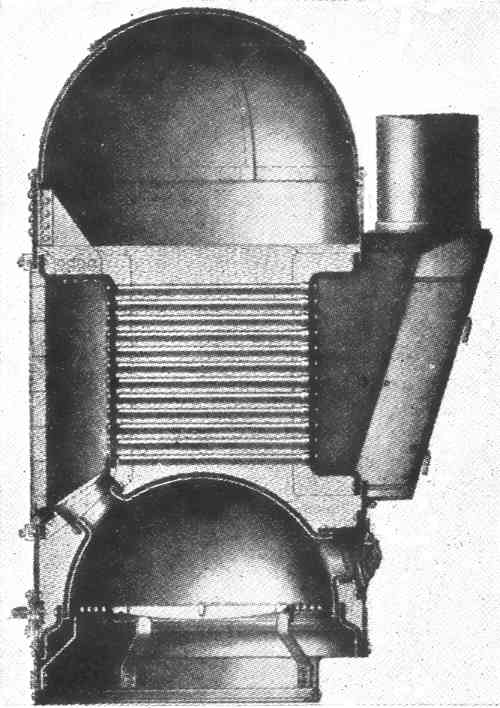
In boiler design the vertical boiler developed to a point where it had horizontal flues, such as the Cochran design. The Cochran boiler water level is set such that all of the heating surfaces are kept below water level and so protected from over-heating.
However, as you can see this is a much more difficult boiler to make as a model.
Tube Faliures
The flue(s) in the simple vertical boiler design suffer from more stress as they are above and below water level. Hence the simplest of vertical boiler design is more likely to fail.
Reasons for boiler tube failures:
- pitting
- stress corrosion cracking
- stress rupture
- creep
- erosion
- thermal fatigue
The horizontal boiler design for my small traction engine still has a number of issues. One is that the firebox is separate to the boiler. This means that heat is lost directly to the firebox and surroundings. One option I have is to line the firebox internally with a firebrick. This will reduce the volume, but it will reflect heat back in.

The multiple small flues in the horizontal boiler design will increase the heating surface area. Also, heating the outer surface of the boiler, even over a small section, will again increase the area.
Conclusions
Hence, my conclusion is that what I have learnt can be transferred to the traction engine boiler. The stress on the flues and silver soldered joints will be lower. Also, getting heat into the traction engine boiler should be easier.
The vertical boiler is interesting in terms of learning how to design, make and operate a boiler. However, it is less efficient than the horizontal boiler. Also, the vertical boiler suffers more from stress, corrosion and fatigue.
In the debate of vertical vs horizontal steam boiler the horizontal boiler wins. To the point that the vertical boiler developed to include many features from the horizontal boiler design.
References
- K. N. Harris, “Model Boilers and Boilermaking”, Tee Publishing, ISBN 1857611144
- E. Molloy, “Steam Engines and Boilers”, George Newnes Ltd